
Prospering While Shrinking: A Japanese Idea
What Japan’s factories and cities reveal about renewing prosperity as populations shrink and industries change.
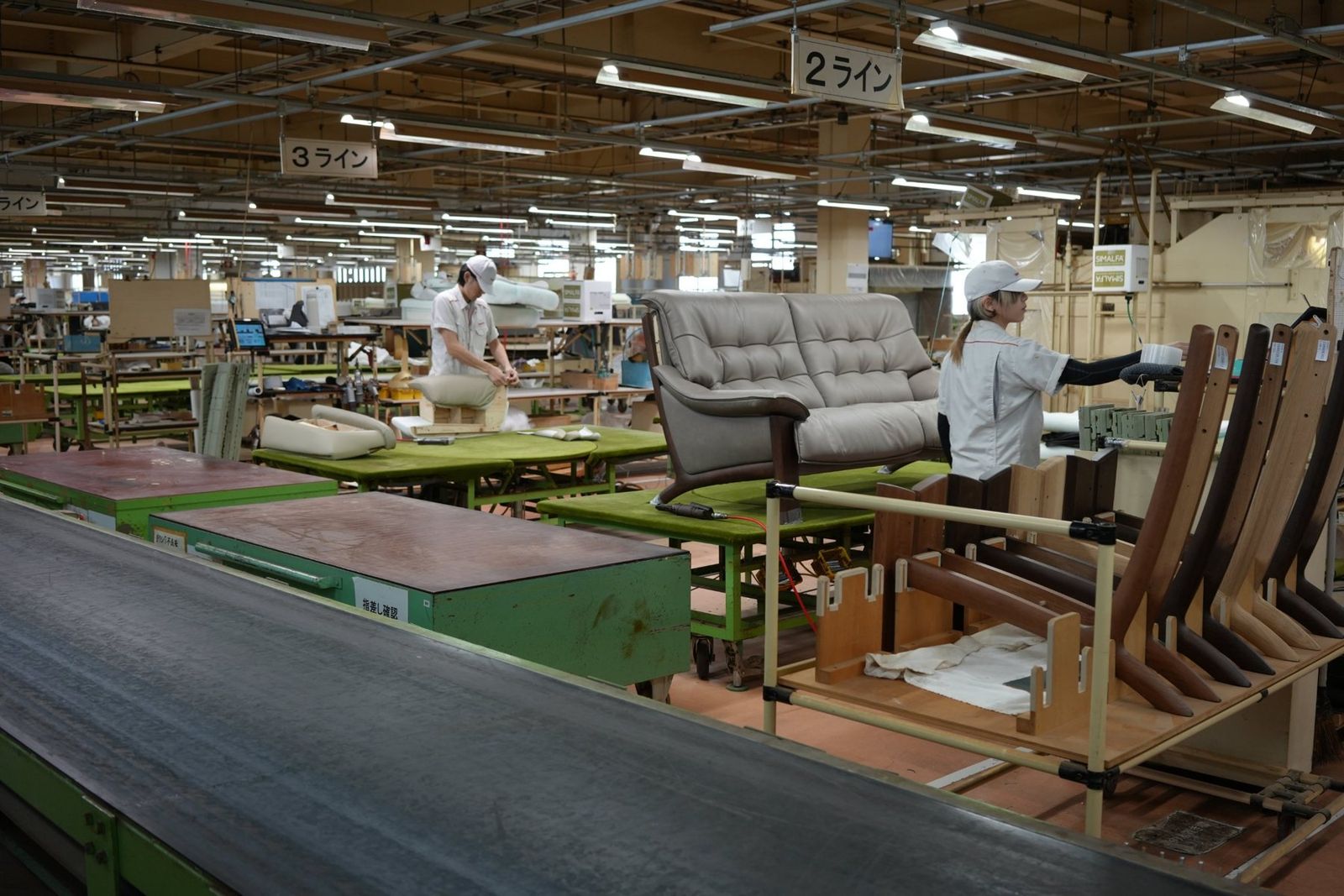 TAV 13.01Furniture plant, lines 2 and 3. Japan.
Last September, I brought my research to Japan. Midway through the journey, Hiroshi Kato, vice president of Karimoku, offered a simple yet radical observation: a tree might take fifty or a hundred years to grow. He wanted the furniture made from it to last just as long.
At the furniture maker’s headquarters in Aichi, an industrial region of central Japan, this was a practical ambition. It required decisions about design, machinery and suppliers that would have consequences long after a piece of furniture left the factory.
Japan’s population is aging and shrinking. Its businesses cannot assume a steadily expanding pool of workers or customers at home. Yet the country retains the skills, buildings and relationships accumulated during decades of industrial expansion. What becomes of that inheritance when the conditions that produced it are changing?
The question ran through my conversations during the week. Hiroshi’s answer began with the wood.
Keeping skills useful
Some Japanese timber had been considered unsuitable for fine furniture. Kato asked designers to find forms that could make it useful: smaller components, thinner legs, different ways of assembling a piece. When they struggled to understand the brief, he took them to the forests and sawmills.
Finding a use for the material also gave work to the people who knew how to handle it. Some timber suppliers had dealt with Karimoku for more than fifty years. Kato visited them regularly to discuss their concerns for the future alongside his own requirements. A problem left unresolved at the sawmill would eventually reach the furniture maker.
Those relationships carried knowledge that would be difficult to replace. Keeping it valuable, however, required a willingness to change what it was used for. That became particularly clear in my conversation with Jessica Cork, who works on global engagement at the Japanese zipper maker YKK.
When American clothing manufacturers moved production overseas, YKK’s customers disappeared. The company developed new applications for its expertise, supplying zippers for car seats and protective clothing, including firefighters’ equipment.
The conversion was difficult. It required different products for more demanding uses. But the company’s operation in Georgia managed to adapt without laying people off.
During our conversation, Jessica connected that response to the founder’s instruction that Japanese employees sent overseas should become part of the communities where they worked. Remaining committed to a place had required changing the business conducted there.
The immediate pressure was the relocation of an industry. YKK’s response illustrated an ability that aging economies also need: putting established skills to work when their original market contracts. The accumulated knowledge of a workforce could support another business, provided someone invested in developing it.
The work beyond the factory
The question becomes broader when the factory site itself needs a new use. A company’s decisions can then help determine what sort of place remains after production has gone.
For Panasonic, the Japanese electronics manufacturer, this had meant turning a former factory site in Fujisawa, south of Tokyo, into a neighborhood of homes, shops, care facilities and shared services. The company had stayed involved through the transformation.
When I asked about profitability, the managers distinguished the profit made from redevelopment from the continuing value of partnerships and opportunities to develop new businesses. Construction had created the neighborhood. Its subsequent life gave companies somewhere to try services and learn what residents needed.
Making that arrangement work required continuing organization. Residents commissioned services through a management company backed by participating businesses. Their board raised proposed changes, while town meetings discussed matters such as car and bicycle sharing. The management company connected residents with providers and the municipality.
There was something curatorial about the role: listening, finding partners and helping the neighborhood develop. Panasonic remains influential, but residents and other businesses are bringing priorities of their own.
The managers acknowledge the difficulty of sustaining agreement as people and partners change. That difficulty is part of the undertaking.
A neighborhood intended to endure would acquire needs its original developers could not fully anticipate. Continuing to invest in the place meant helping others shape its future.
The same attention to everyday life matters to businesses trying to attract workers. A job offer may bring someone to a town; schools and services help make it possible for a family to settle there. This connection was central to what officials described in the city of Hamamatsu, home to the Japanese car and motorcycle maker Suzuki.
City officials are drawing on Suzuki’s longstanding connections with India to open opportunities for other local businesses. The ambition is to bring Indian technological expertise into closer contact with Japanese manufacturing. But recruiting an engineer also means considering the people who might move with them.
That is why Hamamatsu is adapting a former municipal school building to create an international school, with public funding and private operation. It will welcome Japanese children alongside those arriving from abroad.
Officials explained that skilled workers often move with their families. A conversation about industrial recruitment had become a question of where their children would be educated. All this is leading the city to treat family life as a pillar of its industrial future.
What the next generation inherits: regenerative capital
An influential ethical tradition in Japanese capitalism owes much to Eiichi Shibusawa, a statesman who saw the creation of companies as a way to build a nation.
At the counter of a Japanese pub in Tokyo’s Shibuya district, I spoke with Ken Shibusawa, an impact investor and a fifth-generation descendant of Eiichi. He described a cultural inclination among Japanese executives to care about what their successors would inherit and whether their businesses would retain options when circumstances changed. By the end of the week, I had a clearer sense of what that concern could involve.
A skill needed a new customer. A former factory needed another use. An industrial city needed to accommodate the families it hoped to attract. In each case, an existing asset became more valuable through investment in something around it: a product, a service or an institution that allowed people to put it to work.
The benefits could extend beyond the organization making the investment. A school would serve families across businesses. A neighborhood could attract partners with ideas its original developer had never considered. Their usefulness depended partly on giving others room to participate.
Coming from Italy, I kept thinking about towns whose industries had changed while their skills and buildings remained. The Japanese examples suggested where another chapter might begin. For Western communities facing aging populations and industrial change, the practical question is how that inheritance can support new activity—and what must be built around it to make the activity viable.
Prospering while shrinking will require those choices. The people I met were committing fresh resources to places and capabilities whose future could no longer be taken for granted. Their investments offered reasons for people to remain, opportunities for newcomers and uses for knowledge that might otherwise be lost.
M.M. · 2026.10.11.